
India's Bold 100-Day Campaign to Eliminate Child Marriage by 2030: Progress and Promise
- Date & Time:
- |
- Views: 45
- |
- From: India News Bull
New Delhi:
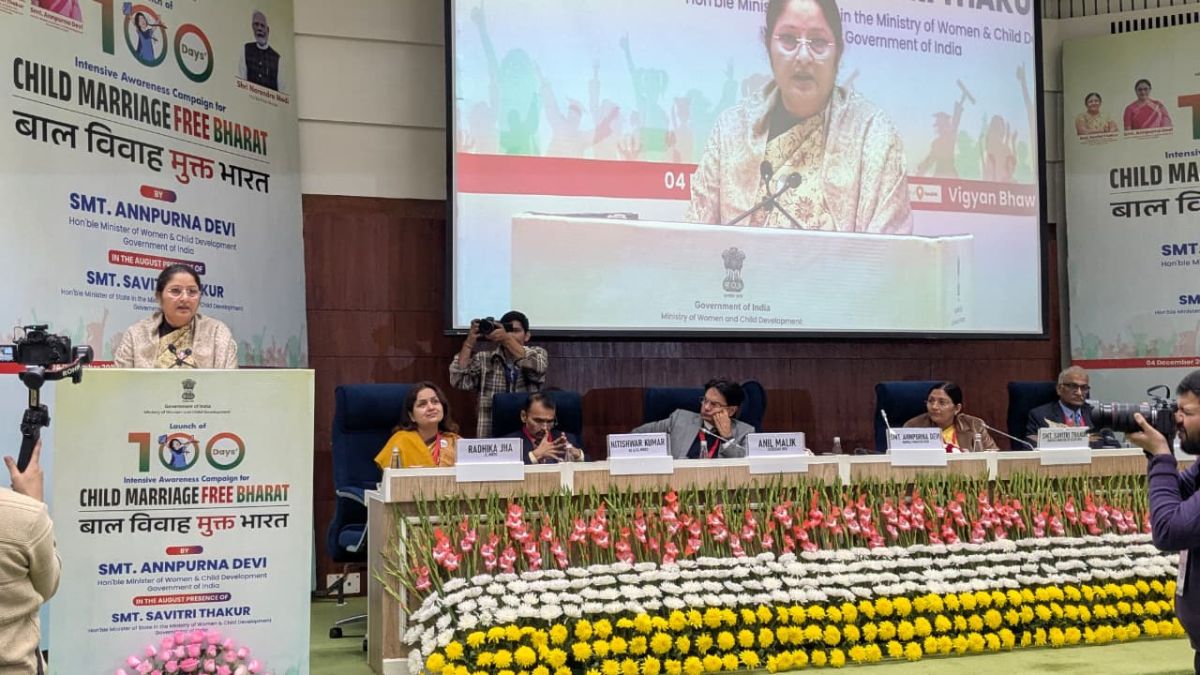
On December 4, the Ministry of Women and Child Development launched a transformative 100-day nationwide campaign at Vigyan Bhawan, New Delhi, aimed at eliminating child marriage in India by 2030. The gathering brought together students, frontline workers, child-rights advocates, ministers, community leaders, and Child Marriage Prohibition Officers (CMPOs) under a unified mission. This event also commemorated the first anniversary of the Bal Vivah Mukt Bharat initiative.
Union Minister Annpurna Devi led the ceremony by administering a national pledge against child marriage. In her address, she emphasized: "The 100-day campaign represents a significant milestone in our comprehensive national movement to eliminate child marriage in India. I sincerely thank everyone supporting the government in achieving this mission's targets, especially dedicated contributors like Bhuwan Ribhu, Founder of Just Rights for Children. Child marriage is a profound injustice that deprives children of their childhood, dignity, and rightful future."
The Minister called for active citizen participation in combating this harmful practice and highlighted the aspirations of young girls nationwide, stating: "Today, every girl across our country shares one slogan: mujhe padhna hai, mujhe badhna hai - and I am proud that the government is fostering and enabling this dream."
The campaign, running from November 27, 2025, to March 8, 2026, features a strategic three-phase approach:
Spell 1 (Nov 27-Dec 31): Educational institutions will organize debates, essay contests, and pledge ceremonies.
Spell 2 (Jan 1-31): Faith leaders, community influencers, and marriage service providers will spearhead awareness initiatives on child rights and safety.
Spell 3 (Feb 1-Mar 8): Gram panchayats and municipal wards will be encouraged to adopt resolutions declaring themselves "child-marriage-free."
This initiative aims to bring discussions directly to communities where child marriages often occur unnoticed.
Child protection network Just Rights for Children is collaborating with the Ministry in this intensive campaign. In conversation with NDTV, child rights activist Bhuwan Ribhu explained the campaign's approach, emphasizing that prevention must precede protection, protection must come before prosecution, and effective prosecution creates deterrence that ultimately strengthens prevention efforts toward ending child marriage by 2030.
Ribhu commended the government's initiatives, noting that India had achieved progress once deemed impossible. He referenced historical global forecasts that predicted extremely slow progress: "UN agencies estimated it would take 300 years to eliminate child marriage. Experts considered it an unattainable goal."
He attributed what he described as an "unprecedented turnaround" to strong political leadership and massive public engagement: "Never before in human history have 250 million people taken a pledge against child marriage on a single day. That transformed our national mindset."
The statistics reflect significant progress:
• 100,000 child marriages prevented within one year
• 630,000 girls re-enrolled in school
• 36,000 Child Marriage Prohibition Officers now operational across India
• Enhanced coordination between police, schools, and panchayats
For Ribhu, these figures represent more than statistics—they indicate India's approach toward a "tipping point" where change becomes irreversible.
Describing the moment as historic, Ribhu stated that India is approaching a crucial juncture: "We are nearing that tipping point from which we can clearly envision the beginning of the end of child marriage in India." He expressed confidence that the country would solve this issue much sooner than previously projected: "It will not take 300 years. We will achieve the vision of a Child Marriage-Free India before 2030."
As this movement gains momentum, it's evident that India isn't merely combating child marriage—it's reshaping the future for its children. This intensive 100-day campaign represents more than a series of events; it signifies a nationwide awakening. With child marriage rates declining significantly and community involvement reaching unprecedented levels, the nation stands closer than ever to achieving what once seemed impossible. If this momentum continues, India may indeed reach a historic milestone—becoming Child Marriage-Free by 2030.
Source: https://www.ndtv.com/india-news/a-hundred-days-of-hope-indias-new-push-to-end-child-marriage-by-2030-9750626