
Opinion | Who Is Scott Bessent - Tariff Hawk, Yen Man, And India's New Headache?
Recently, Bessent told Europe that it is not doing its part because it is yet to join the US in imposing secondary tariffs on India. "It's put up or shut up time," he told Europe.
- Date & Time:
- |
- Views: 55
- |
- From: India News Bull
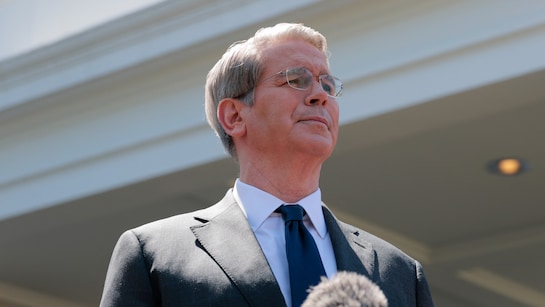
US Treasury Secretary Scott Bessent has emerged as a formidable challenge for India following President Donald Trump's series of tariff impositions. In a recent Bloomberg TV interview, Bessent warned that India could face sanctions or increased secondary tariffs if it continues purchasing Russian oil while President Putin remains uncooperative in negotiations.
The Alaska Summit between Trump and Putin did not immediately produce an agreement, though diplomatic efforts continue with hopes of ending the Russia-Ukraine conflict soon. The Trump administration believes that pressure on India's Russian oil purchases helped bring Putin to the negotiating table, despite Trump seemingly downplaying this factor in a post-summit Fox News interview. Bessent has criticized Europe for not joining the US in implementing secondary tariffs on India, bluntly stating "It's put up or shut up time." He described India as "bit recalcitrant" in trade negotiations, which failed to reach an agreement by the August 9 deadline despite early positive momentum from Prime Minister Modi's White House visit during Trump's first month in office.
Also Read | "Trump Didn't Lose, Putin Clearly Won": Ex-US NSA John Bolton On Alaska Summit
While Elon Musk and JD Vance initially dominated attention in Trump's administration, Bessent has now risen as one of the cabinet's most influential figures, enjoying both the President's confidence and Wall Street's trust.
In his Bloomberg interview, Bessent expressed expectations that trade partners would adjust policies to mitigate high tariff impacts, and that US exporters would reduce margins to offset new American levies. Shortly thereafter, India announced long-awaited simplification of its GST regime, including faster credits and refunds. While still being fine-tuned, these changes are expected to benefit exporters by reducing input and financing costs, allowing for modest price reductions.
Another Bessent comment may indirectly affect India. During his Bloomberg interview, he publicly advised the Bank of Japan to raise interest rates, stating, "They're behind the curve. So they're going to be hiking, and they need to get their inflation problem under control." This statement, which he characterized as personal opinion, followed his meeting with BoJ governor Kazuo Ueda. Bessent also suggested, echoing Trump, that US rates are excessively high and urged the Federal Reserve to significantly reduce them.
This represents an unprecedented public expression of personal opinion aimed at creating a favorable global policy environment for the US dollar and American borrowers. While divergent views between political leadership and autonomous central banks on interest rates are common, it's rare for a major economy's finance minister to publicly offer unsolicited advice to another country's central bank.
Following comments from Bessent, once nicknamed "the man who broke the BoJ" in Japan, the yen strengthened significantly. This places the BoJ in a difficult position - raising rates could appear to be yielding to US pressure, even if warranted, potentially causing markets to scrutinize every US policymaker's comment on Japan. It also undermines Japanese policymakers' ability to influence markets through measured statements. Eisuke Sakakibara, Japan's vice finance minister in the late 1990s, was famously known as 'Mr Yen' for his ability to move currency markets with his statements. Japan is already perceived as making significant concessions to Trump's demands, having recently signed a trade agreement including an unusual $550 billion investment commitment to be deployed in core industries at US discretion.
Bessent has extensive experience with Japan, maintaining relationships with influential Japanese policymakers and profiting substantially from Japan's economic policies. In the Fall 2022 issue of International Economy Magazine, Bessent, then founder and CEO of hedge fund Key Square Group, described a 2012 meeting he and George Soros had with a key advisor to Shinzo Abe, who was preparing for his second term as Prime Minister. The advisor outlined the comprehensive policies Abe planned to implement if elected.
At that time, Japan was struggling through an extended recession, and Abe had pledged to revitalize the economy with his "Three Arrows: loose monetary policy, fiscal flexibility, and structural economic reforms."
Also Read | Putin Dials PM Modi, Shares Insights On Meeting With Trump Over Ukraine War
After the meeting, Bessent recalls Soros asking if Abe's plan would succeed. Bessent responded, "I'm not sure whether it will work, but it will be the market ride of a lifetime." As Abe implemented his radical agenda, investors flocked to Japanese assets, and Bessent and his associates reportedly profited handsomely.
Central banks worldwide coordinated policies for years following the 2008-09 Global Financial Crisis, but this informal arrangement dissolved after the COVID-19 pandemic. Japan maintained ultra-loose monetary policy for over a decade until March 2024, when the BoJ raised its benchmark rate from negative 0.1% to 0.1%. Unexpectedly, it increased rates again to 0.25% in July - the first Japanese rate hikes in 17 years.
The BoJ's surprise July 2024 rate hike caught markets off guard and significantly impacted the "yen carry trade." The yen had been a preferred currency for borrowing due to low interest rates combined with Japan's economic size and stability. These borrowings were typically converted to US dollars for investment in profitable assets worldwide, including Indian equities. The July hike prompted rapid global unwinding, affecting India, though the impact proved temporary.
While further rate increases weren't expected short-term, persistent inflation might force the BoJ to raise rates by year-end. US pressure could create timing and magnitude surprises, potentially hitting India harder due to concurrent US tariff pressures.
A Japanese rate hike would directly affect Indian borrowers, whose yen loan exposure has been growing. Companies including Reliance Industries, Bank of India, REC, Tata Semiconductor, JSW Steel, and PFC have borrowed in yen. Numerous infrastructure projects also rely on Japanese loans. While the interest rate increases themselves might not substantially affect borrowing costs given their current low levels, repayment could become more expensive than anticipated.
(Dinesh Narayanan is a Delhi-based journalist and author of 'The RSS And The Making Of The Deep Nation'.)
Disclaimer: These are the personal opinions of the author