
"Trump Is Not Happy With India Because...": What Ex-Diplomat Said
One of the reasons behind Washington's punitive tariffs on New Delhi is that US President Donald Trump is miffed with India for ignoring his so-called role in brokering a peace deal with Pakistan following the recent military conflict.
- Date & Time:
- |
- Views: 48
- |
- From: India News Bull
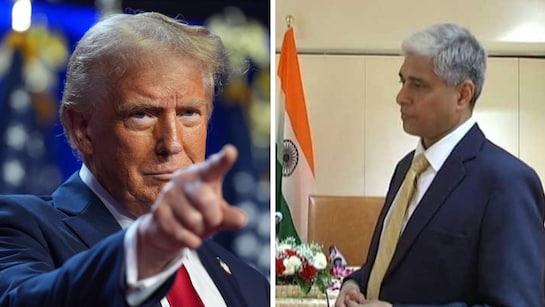
Former Indian diplomat Vikas Swarup has shared insights on the strained US-India relations under the Trump administration, describing Washington's relationship with Pakistan as merely tactical and short-term.
New Delhi:
Former diplomat and acclaimed author Vikas Swarup has revealed that President Donald Trump's decision to impose punitive tariffs on India stems partly from his dissatisfaction over New Delhi's refusal to acknowledge his claimed role in mediating tensions with Pakistan following May's military confrontation. Speaking to ANI, the former High Commissioner to Canada characterized US-Pakistan relations as a "tactical, short-term arrangement" driven primarily by financial interests, while maintaining that US-India ties remain fundamentally strategic.
Swarup commended India's firm stance against yielding to Trump's trade demands and suggested that the US tariffs would ultimately trigger inflation within America itself.
Explaining the US Tariff Decision
"We have to understand why these tariffs have been imposed... One, Trump is not happy with India because we are a member of BRICS... he has got this notion that BRICS is an anti-American alliance which is hell-bent on creating an alternative currency to the dollar... he feels that India should not be a member of the BRICS," Swarup explained during his ANI interview.
Swarup further elaborated that Trump's displeasure stems from India's unwillingness to credit him for brokering peace with Pakistan after Operation Sindoor in May. India has consistently maintained that the US played no mediating role in the ceasefire negotiations, as New Delhi rejects external mediation in its bilateral matters. The truce was instead directly negotiated between the military establishments of both countries at Pakistan's request.
"Trump has now said almost 30 times that it was he who got the two countries to stop back from the brink, who stopped a nuclear conflagration in the subcontinent. So, he is miffed that India has not acknowledged his role, whereas Pakistan has not only acknowledged his role but has even nominated him for a Nobel Peace Prize," noted Swarup.
India's Operation Sindoor was launched in early May following the Pahalgam terror attack, involving precision strikes against terror infrastructure in Pakistan and Pakistan-occupied Kashmir. India successfully repelled subsequent Pakistani aggression and targeted their airbases.
The former diplomat highlighted that India has resisted US pressure to provide greater access to its agriculture and dairy sectors during trade negotiations, prompting Washington to employ pressure tactics to secure agreement to its "maximalist demands."
"This is part of his pressure tactics to get India to sign on the dotted line on the maximalist demands that the US is making with regard to access to our dairy and agriculture, and genetically modified (GM) crops. We have not caved in, and it is also in a way a signal to Russia because he is also frustrated that he has not been able to get President Putin to agree to the ceasefire that Zelensky has agreed to," he said.
Trump and Putin are scheduled to meet in Alaska on Friday, raising concerns among Kyiv and its allies that the two leaders might attempt to dictate peace terms for the ongoing conflict.
Trump's Nobel Prize Ambitions
Swarup pointed out that the billionaire president, known as a dealmaker, "has now made it his unique selling point that he is the peacemaker."
"Look at the number of conflict situations that he has mediated in, whether it is Thailand and Cambodia, Rwanda and the Democratic Republic of Congo, Armenia and Azerbaijan; he has injected himself into each of those. He feels that the biggest one of these was the India and Pakistan one because these two are nuclear powers. So, from that point of view, Trump feels that he deserves credit," he observed.
The former diplomat noted that Barack Obama remains the only American President to have received the Nobel Peace Prize, and Trump "really wants to do one better than Obama."
"He has made no secret of his longing for that Nobel Peace Prize. He is hoping that if he could not get it for these, if he is able to bring about a ceasefire between Russia and Ukraine, then that might be his ticket to the Nobel Peace Prize," Swarup added.
Understanding US-Pakistan Relations
According to Swarup, India's foreign policy approach is not responsible for the recent US tilt toward Pakistan. He suggested that Islamabad has gained greater influence in Washington through lobbying efforts and strategic communications firms.
"Pakistan, through some intermediaries, has gotten the ear of the US President, and that is why, two visits by Asim Munir to Washington, the so-called 'deal' with America on the so-called 'oil reserves' of Pakistan," he explained.
Swarup also highlighted Pakistan's efforts to position itself as a cryptocurrency hub, noting that in April, a cryptocurrency venture backed by President Trump signed a letter of intent with Pakistan's crypto council.
"I think Pakistan is now trying to position itself as the 'Crypto King' of South Asia, and there, through World Liberty Financial, in which Trump's family has stakes, Steve Witkoff's (Trump aide and US Envoy to the Middle East) family has a stake, through that I think Pakistan has managed to project an image of itself as a reliable partner... All these things have led to Trump having a softer approach towards Pakistan," he said.
"But that does not mean that he has given up on India or that India is now an adversary for him. I think this is part of his pressure tactics to secure a more favourable deal. India should not cave in because our strategic autonomy is non-negotiable," Swarup emphasized.
Contrasting US Relations with India and Pakistan
Swarup characterized America's relationship with Pakistan as tactical and temporary, primarily motivated by potential financial gains for the Trump and Witkoff families from Pakistani cryptocurrency ventures. In contrast, he described US-India ties as more strategic and less transactional.
"I think the (United States') relationship with Pakistan right now is a very tactical one and is a short-term one, primarily motivated by the financial gain that the Trump family and Witkoff family hope to make from the cryptocurrency assets in Pakistan. With India, I think, the relationship is much more strategic. It is not so transactional as it is with Pakistan. That is why I feel that it is a passing phase. I call it a storm, not a rupture. You just have to wait out the storms. All storms eventually pass," he stated.
He added, "I think it's a strategic mistake on the part of the US that you are getting in bed with Pakistan, which is in bed with China. China is the US' strategic competitor."
Trump's Tariff Policies
Swarup praised India's decision to resist US pressure in trade negotiations, noting that "the US called India a 'Tariff King' but now the 'Tariff King' in the world is the United States." He predicted that Trump's tariff policies would ultimately increase inflation in America.
"The US called India a 'Tariff King'. But now the 'Tariff King' in the world is the United States because our average tariff is about 15.98 per cent. The US tariff today is 18.4 per cent. So, it is now the 'Tariff King' of the world. But the fact is, tariffs are bringing in money. They will bring in about 100 billion dollars a year for the US. But the issue is that eventually, who will pay for these tariffs? By American consumers. So, what's going to happen is this is going to ratchet up inflation in America, it's going to ratchet up prices in America. I think that's when the chickens will come home to roost," he explained.
"If you cave in to a bully, then the bully will increase his demands. Then there will be even more demands. So, I think we have done the right thing. India is too large, too proud a country to become a camp follower of any other country. Our strategic autonomy has been the bedrock of our foreign policy right from the 1950s. I don't think that any Govt in Delhi can compromise on that," he added.
President Trump announced 25 percent tariffs on Indian goods plus an unspecified penalty in July, despite expectations of an interim India-US trade deal that might