
Opinion | Can India Help Pull Putin Away From Xi? Or, Should It?
In recent weeks, many in India have wondered if it was right to rely more on the West in recent years and weaken relations with its old-time, traditional ally, Russia.
- Date & Time:
- |
- Views: 48
- |
- From: India News Bull
Recently, India's Deputy Chief of Army Staff, Lieutenant General Rahul R Singh, confirmed what defense analysts have long suspected: China actively supported Pakistan during India's Operation Sindoor. Speaking at a FICCI event, Singh noted that China was employing its ancient "36 stratagems" military doctrine against India, particularly the strategy of "killing with a borrowed knife."
While China's role as Pakistan's primary military and diplomatic supporter is well-established, including its plans to sell Islamabad numerous 5th-generation fighter jets, it remains uncommon for high-ranking Indian military or government officials to explicitly identify China as India's principal threat, despite India's strategic policies clearly being oriented toward countering its powerful neighbor.
Singh's remarks came shortly after US President Donald Trump hosted Pakistani military chief Asim Munir at the White House. Previously, US Central Command head Gen. Michael Kurilla had characterized Pakistan as a "phenomenal partner" in counter-terrorism efforts, emphasizing America's need for strong relations with both Pakistan and India.
Post-Pahalgam AssessmentIndia's military response to the Pahalgam terror attack failed to secure unambiguous support from major global powers, disappointing many Indians who expected international recognition of India's self-defense rights following the terrible attack. World leaders condemned the attack but offered little substantive backing, despite being aware of China's military assistance to Pakistan.
Many were dismayed by Western leaders' continued equating of India with Pakistan, despite New Delhi's two-decade effort to strengthen economic and defense ties with the West. Munir's warm reception in Washington underscored Islamabad's continued importance to American regional interests.
Given that India has maintained strategic autonomy rather than becoming a treaty partner with the United States, the tepid Western response shouldn't have been surprising to New Delhi. Nevertheless, this situation highlights a significant challenge for India.
The Chinese ChallengeIndia must reassess its strategic relationships to address the increasingly deep military cooperation between Pakistan and China. A compelling case exists for reinforcing India's strategic partnership with Russia while maintaining similar ties with the United States.
As this article explains later, Moscow is also seeking to reduce its dependence on Beijing, which has grown considerably since the Ukraine conflict began. The US and other Western nations would welcome such a development.
Recently, many Indians have questioned whether shifting toward Western partnerships while allowing relations with traditional ally Russia to weaken was prudent. They've recalled Moscow's support during the 1971 war when Western powers and China backed Pakistan.
Although Russia's response to the Pahalgam incident has been similar to the West's, historically Russia has remained loyal to India. When India conducted its first nuclear explosion in 1974 and further tests in 1998, Moscow stood by India, refusing to join Western nations in imposing sanctions.
Russia remained crucial to India's atomic program during India's nuclear isolation by Western powers. Only in the past two decades has the United States developed a strategic partnership with New Delhi, partly to counter China's growing influence. Yet India still relied on Russia for nuclear-powered submarines, which the US consistently refused to provide. Now, India is developing such capabilities domestically.
The Su-57Russia has offered India its fifth-generation stealth fighter Su-57 with remarkably favorable terms—seven years after India withdrew from their joint fighter production project. Russia is willing to manufacture the fighter in India, share complete source code, and transfer technology—concessions Western countries remain reluctant to make. This could significantly advance India's fifth-generation aircraft program.
Naturally, India's political leadership must respect military experts' assessments if they favor the American F-35 over the Russian fighter. Nevertheless, the Russian option merits serious consideration.
Why India Could Be A Preferred PartnerRussia has shown greater willingness to collaborate with India on high-tech defense projects compared to China. Moscow is particularly hesitant to share advanced aviation expertise with Beijing, an area where China reportedly still lags behind both the US and Russia.
India and Russia might even jointly produce the S-500 missile defense system, building on the success of the S-400 system against Pakistan last month. The two nations already co-produce several defense platforms, including the BrahMos supersonic cruise missile, which was deployed against Pakistan in the recent conflict.
Thus, despite India's diversified defense relationships over the past decade, Russia remains its most significant partner.
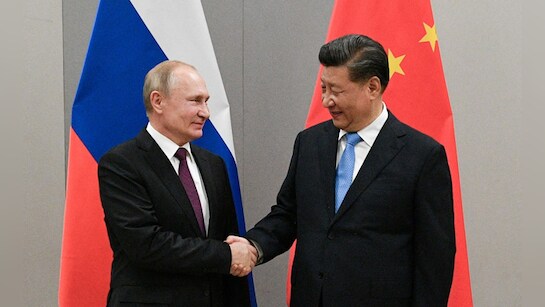
The past three years have been challenging for Russia following President Vladimir Putin's Ukraine invasion, which pushed Russia into closer alignment with China. Three weeks before the invasion, Xi Jinping announced a "no-limits partnership" with Putin. Western military support for Ukraine and economic sanctions have intensified pressure on Russia.
While officially neutral, China has supported Russia throughout the conflict. According to American officials, Beijing has supplied Moscow with substantial quantities of machine tools, drones, turbojet engines, microelectronics, and nitrocellulose—materials Russia uses in weapons production.
Relationship TensionsHowever, the China-Russia partnership has limitations, with mutual suspicion evident. A recently leaked Russian intelligence agency (FSB) report describes China as "the enemy." This FSB assessment, reported in the New York Times last month, identifies China as a serious threat to Russian security, noting that "Beijing is increasingly trying to recruit Russian spies and access sensitive military technology, sometimes by enticing disaffected Russian scientists." The report warns of Chinese territorial encroachment in the Pacific, where longstanding disputes exist, and notes China's growing influence in Central Asia and espionage activities in Russia's Arctic territories.
This warning suggests Moscow might be persuaded to loosen ties with Beijing given the opportunity. Though India currently cannot replace China's role, Russia would welcome stronger strategic relations with New Delhi.
Beijing's diplomatic support for Moscow during the Ukraine conflict has been less than absolute. Like India, China has abstained from most UN resolutions regarding Ukraine over the past three years. China has also unsuccessfully pressured Russia against selling advanced defense systems to India, such as the S-400 anti-missile defense shield.
Separating Putin From XiMeanwhile, Trump has been attempting to distance Russia from China through continued outreach to Putin. A strong Moscow-Beijing alliance presents a serious challenge to Washington, but if Russia can be persuaded to shift its alignment, America could focus more directly on addressing the Chinese challenge.
Even before his November election, Trump declared his intention to "un-unite" Putin and Xi. To achieve this, he first aims to end the Russia-Ukraine conflict to reduce Moscow's dependence on China.
However, Putin remains skeptical of Trump and the American establishment, where he is viewed with suspicion. America's European allies still consider Moscow a greater threat than China, at least currently.
China's Ukraine War BenefitsXi Jinping is concerned about Trump's efforts to separate Putin from China. In February, shortly after Trump intensified efforts to end the Ukraine war, Xi reaffirmed China's "no-limits" partnership.
China benefits from Russia's continued engagement in the conflict. The war's end could improve Russia-US relations and reduce Moscow's dependence on Beijing. The conflict also depletes American military equipment through constant supplies to Ukraine—a situation favorable to Beijing.
Peace with Ukraine could lead to the lifting of American sanctions, helping Russia rebuild its economy and revitalize its arms industry, which currently depends on China for many components. This would also benefit India, as Indo-Russian defense projects would gain new momentum.
Any reduction in Chinese influence in Russia would be advantageous for India. Since the Ukraine war began, the Modi government has maintained neutrality despite Western pressure. India has also benefited from discounted Russian oil, which increased from just 2% of imports before the war to 40% by last year.
However, Xi is unlikely to easily relinquish Beijing's influence over Moscow. Last year, Russia-China trade reached a record $245 billion—66% higher than in 2021, before the Ukraine war began. This increase was largely driven by Chinese exports of civil-military dual-use goods. China has now surpassed India as Russia's largest crude oil purchaser.
Washington's ConcernsCertainly, closer India-Russia strategic cooperation will raise concerns in Washington and other Western capitals. However, India should be able to convince Western partners that, unlike China, India is not aligning with Russia to threaten Western interests, but rather aims to reduce Moscow's dependence on Beijing.
As part of its multi-polar foreign policy, India must continue deepening its strategic relationship with the United States—the only power still capable of effectively countering China. India and the US need each other to address the Chinese threat. Americans recognize that India has never posed a security threat to them. While Pakistan may serve certain American interests, it has previously compromised US security—a key reason why the US remains