
"So-Called Court Of Arbitration On Indus Waters Treaty Illegal, Void": India
India has, in a strongly-worded statement, rejected a "supplemental award" by an "illegal" Court of Arbitration set up supposedly over the 1960 Indus Waters Treaty.
- Date & Time:
- |
- Views: 75
- |
- From: India News Bull
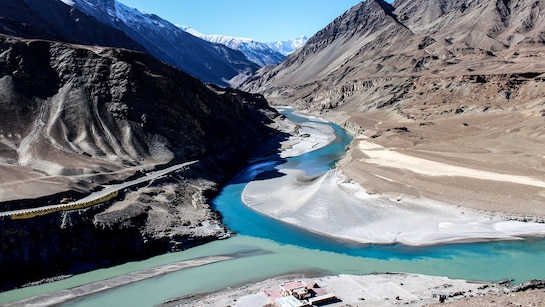
India has suspended the Indus Treaty until Pakistan eliminates its terrorist infrastructure and networks
New Delhi:
India has forcefully rejected a "supplemental award" issued by what it terms an "illegal" Court of Arbitration allegedly established under the 1960 Indus Waters Treaty. India's foreign ministry denounced the self-appointed panel as unlawful and operating in "brazen violation" of the treaty itself, dismissing all its claims and "concerns" as invalid.
The Ministry of External Affairs released a five-point statement declaring, "Today, the illegal Court of Arbitration, purportedly constituted under the Indus Waters Treaty 1960, albeit in brazen violation of it, has issued what it characterizes as a 'supplemental award' on its competence concerning the Kishenganga and Ratle hydroelectric projects in the Indian Union Territory of Jammu and Kashmir."
Clarifying India's stance, the foreign ministry emphasized that New Delhi has never acknowledged this self-appointed 'arbiter' as having any legitimate standing in India's affairs, stating that "India has never recognised the existence in law of this so-called Court of Arbitration, and India's position has all along been that the constitution of this so-called arbitral body is in itself a serious breach of the Indus Waters Treaty."
"Consequently, any proceedings before this forum and any award or decision taken by it are also for that reason illegal and per se void," the statement added.
The foreign ministry directly attributed the "abeyance" of the Indus Waters Treaty to Pakistan's support for terrorism, reiterating that "Following the Pahalgam terrorist attack, India has in exercise of its rights as a sovereign nation under international law, placed the Indus Waters Treaty in abeyance, until Pakistan credibly and irrevocably abjures its support for cross-border terrorism. Until such time that the Treaty is in abeyance, India is no longer bound to perform any of its obligations under the Treaty."
India accused the "so-called Court of Arbitration" of acting on Pakistan's behalf and emphasized that the panel has "no existence in the eyes of the law," declaring that "No Court of Arbitration, much less this illegally constituted arbitral body which has no existence in the eye of law, has the jurisdiction to examine the legality of India's actions in exercise of its rights as a sovereign," and adding that "India, therefore, categorically rejects this so-called supplemental award as it has rejected all prior pronouncements of this body."
Describing Pakistan as the global epicenter for terrorism, India asserted that "This latest charade at Pakistan's behest is yet another desperate attempt by it to escape accountability for its role as the global epicenter of terrorism. Pakistan's resort to this fabricated arbitration mechanism is consistent with its decades-long pattern of deception and manipulation of international forums."
India has explicitly stated that the Indus Waters Treaty will remain suspended until Pakistan completely eliminates all terrorist infrastructure, financing, and operatives from its territory. New Delhi has also warned both Pakistan and the international community that any terrorist activity or attack in India with Pakistani connections, direct or indirect, will be considered an escalation warranting a military response by India "anywhere in Pakistan".
The suspension of the Indus Waters Treaty was among the first diplomatic punitive measures India took against Pakistan after the Pahalgam terror attack was linked to Pakistani involvement. Prime Minister Narendra Modi has declared that "blood and water cannot flow together." India has consistently maintained that "terror and talks cannot happen at the same time," leaving Pakistan and its military leadership in Rawalpindi with no alternative but to end its "cross-border terror" policy to regain its water share under the agreement.
Under the 1960 Indus Waters Treaty, India had, as a goodwill gesture, generously agreed to share waters from the Indus river and its five tributaries - Baes, Sutlej, Ravi, Chenab, and Jhelum - on mutually acceptable terms. According to the agreement, the waters of the three 'western rivers' - Indus, Jhelum, and Chenab - are to be released to Pakistan as per agreed conditions, while India retains the entire volume of water from the three 'eastern rivers' - Baes, Sutlej, and Ravi. The treaty includes detailed provisions for dam construction, annual data sharing, and numerous other factors.