
'Extremely Rewarding Day': Shashi Tharoor On Meeting US Congressmen, Senators
The multi-party delegation of Indian parliamentarians had an "extremely rewarding" day meeting US Congressmen and Senators at Capitol Hill, briefing them about Operation Sindoor and India's fight against terrorism, Congress MP Shashi Tharoor said.
- Date & Time:
- |
- Views: 50
- |
- From: India News Bull
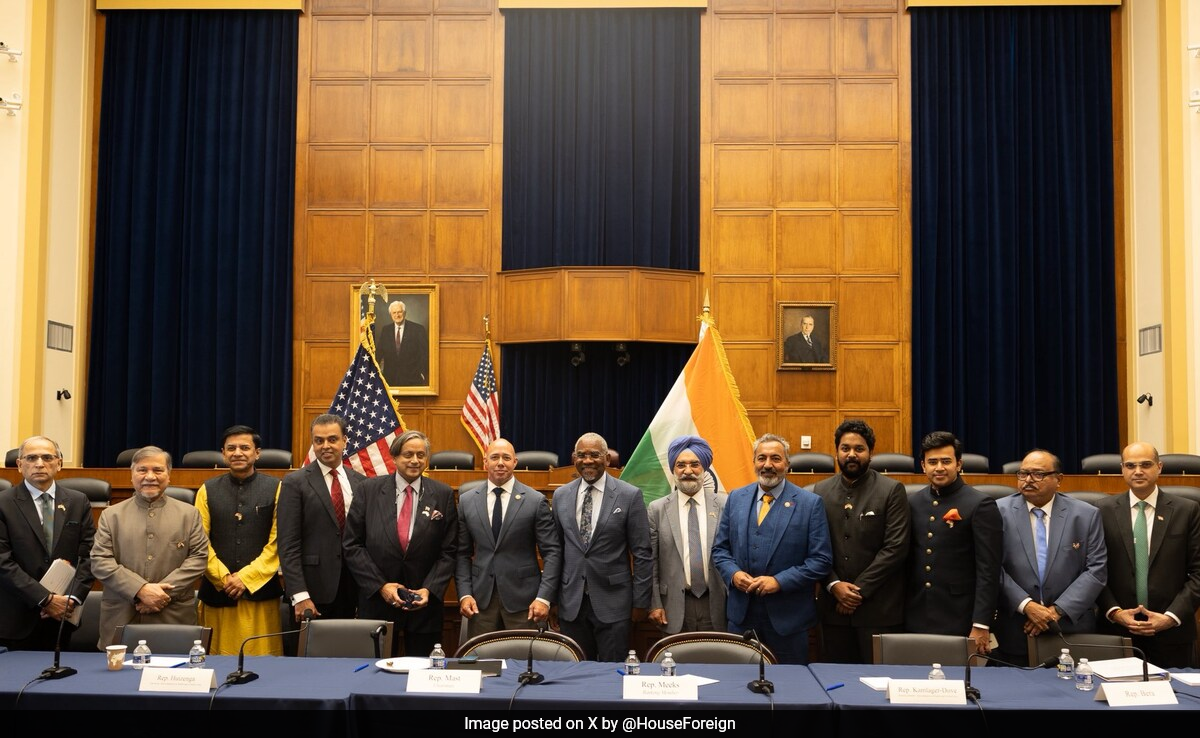
Indian parliamentary delegation seeks international support against terrorism through diplomatic engagements.
Washington:
The cross-party Indian parliamentary delegation experienced an "extremely rewarding" day of meetings with US lawmakers at Capitol Hill, where they discussed Operation Sindoor and India's counterterrorism efforts, according to delegation leader Shashi Tharoor of Congress.
"Our day at Capitol Hill proved extremely rewarding as we engaged with numerous Congressmen and Senators," Mr Tharoor stated during a discussion at The National Press Club in Washington on Wednesday.
The delegation, which departed from India on May 24, visited Guyana, Panama, Colombia, and Brazil before arriving in Washington for the final segment of their international tour. Their mission: to articulate India's position against terrorism following the Pahalgam terror attack and the subsequent Operation Sindoor.
The delegation includes MPs Sarfaraz Ahmad, Ganti Harish Madhur Balayogi, Shashank Mani Tripathi, Bhubaneswar Kalita, Milind Deora, Tejasvi Surya, and former Indian ambassador to the US Taranjit Sandhu. They reached Washington on Tuesday and commenced an intensive schedule of engagements with American lawmakers and officials the following day.
"In each country, our primary objective has been to present our perspective on recent events, share our experiences from the past few weeks, and seek solidarity and understanding. I'm pleased to report that our success rate has been perfect thus far," Mr Tharoor explained.
He noted that everyone they had met unequivocally condemned the terrorist attack on India, expressed outrage and sympathy, and explicitly supported India's right to defend itself against terrorism.
"This understanding has been tremendously reassuring," he stated, adding that "we left Capitol Hill very satisfied with both the quality of discussions and the level of interest shown."
"Every country, including those on Capitol Hill, has demonstrated significant interest in strengthening relations with India across multiple domains. It extends beyond solidarity against terrorism to include positive thinking about economic development cooperation, trade, and investment," he remarked.
During a press conference at the Indian Embassy, Mr Tharoor later emphasized that in their meetings with US lawmakers and congressmen, "we didn't encounter a single skeptical or negative voice."
"On the contrary, we received an exceptionally positive response," he stated. "Our sessions were highly productive." He summarized the meetings with two key observations: complete support and solidarity for India in its counterterrorism efforts, and thorough understanding of India's right to self-defense against terrorism.
On both points, the message was "extremely clear."
The delegation met with bipartisan co-chairs of the House India Caucus, Congressmen Ro Khanna and Rich McCormick, along with vice co-chairs Congressmen Andy Barr and Marc Veasey.
The parliamentarians briefed Caucus members "on the cross-border terrorism India faces and India's strong, resolute stance in combating terror," according to the Indian Embassy's post on X.
"The congressmen expressed unequivocal, bipartisan condemnation of the Pahalgam terror attack. They affirmed support for India's right to respond to terrorism with zero tolerance. Caucus members also praised the robust strategic partnership between India and the US," the post stated.
The delegation held a "candid and fruitful exchange" with the House Foreign Affairs Committee leadership, including chair Representative Brian Mast, ranking member Representative Gregory Meeks, South and Central Asia subcommittee chair Rep. Bill Huizenga, ranking member Congresswoman Sydney Kamlager-Dove, ranking member Representative Ami Bera, and East Asia and Pacific subcommittee representative Young Kim.
"The Parliamentary delegation briefed committee members on Operation Sindoor's success in establishing a new normal in India's fight against cross-border terrorism. The committee leadership unequivocally condemned the Pahalgam attack. India and the USA stand united in their unwavering resolve to combat terrorism in all forms," the embassy stated on X.
The delegation received a "warm reception" at the United States Capitol from a bipartisan group of senior US Senators, including prominent members of the Senate Foreign Relations Committee, Senate Intelligence Committee, and the Senate India Caucus.
The parliamentarians discussed Operation Sindoor's success, detailed Pakistan-sponsored cross-border terrorism, and outlined India's firm determination to appropriately address any such future incidents.
The embassy expressed appreciation to leaders of the Senate Foreign Relations Committee (SFRC) subcommittee on South Asia and Counterterrorism, Senators Dave McCormick and Jacky Rosen, for hosting the meeting, and to SFRC Chairman Senator Jim Risch, Vice Chairman of Senate Intel Committee Senator Mark Warner, SFRC and Intel Committee member Senator John Cornyn, and Intel Committee member Senator Elissa Slotkin "for participating in the substantive and productive discussion."
Addressing a question about Secretary of Commerce Howard Lutnick's recent comment that certain Indian government actions "generally rubbed the United States the wrong way," particularly India's military equipment purchases from Russia, Mr Tharoor acknowledged a "steady change" in India's weapons procurement patterns.
He explained that India still requires numerous Russian spare parts, but "dependency has significantly decreased from its peak."
He contrasted this with Pakistan, noting that "81 percent of Pakistan's weapon systems and imports come from China."
"We don't have that level of dependence. We've diversified our sources, incorporating American weaponry, and we're actively interested in acquiring more. Whatever the Americans are willing to discuss and sell to us, we certainly hope to move forward," he said, adding that India also purchases defense equipment from France and Israel.
Addressing a similar question during the Indian Embassy press briefing, Surya confirmed the issue arose in several discussions.
"We clearly explained to the Americans that unlike Pakistan, which sources 81 percent of its armaments and military hardware from China, India's military hardware is increasingly indigenous and highly diverse," Surya stated.
"We maintain a diverse portfolio of supplier countries with whom we have tactical and strategic partnerships," unlike Pakistan's heavy reliance on China for military equipment, Surya emphasized.
"Recently, Pakistan has been depending on inexpensive Chinese imports, including military hardware that has failed spectacularly in combat. Perhaps they struggle to process the reality of high-quality, high-caliber military equipment and strong democratic leadership on the other side of the border," Surya remarked.
Tensions between India and Pakistan escalated following the April 22 Pahalgam terror attack, with India conducting precision strikes against terrorist infrastructure in Pakistan and Pakistan-occupied Kashmir early on May 7.
Pakistan attempted attacks on Indian military installations on May 8, 9, and 10. India responded forcefully to these provocations.
The ground hostilities concluded with an agreement to cease military actions after discussions between the directors general of military operations from both countries on May 10.