
Opinion | Bangladesh Can't Wish Away Its Dependence On India, Even If It Wants To
- Date & Time:
- |
- Views: 65
- |
- From: India News Bull
Pakistan's Foreign Minister, Ishaq Dar, recently conducted discussions with key Bangladeshi officials and politicians, including Chief Adviser Muhammad Yunus, in what analysts view as a mutual endeavor to restore damaged diplomatic relations. This visit represents the first by a Pakistani Foreign Minister to Bangladesh in 13 years, with Hina Rabbani Khar's short trip in 2012 being the previous instance.
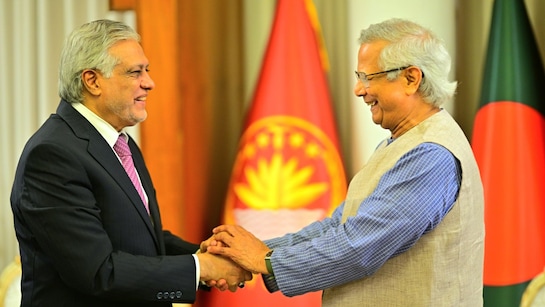
During the diplomatic engagement, the two nations signed six significant agreements to formalize cooperation across economic sectors, diplomatic channels, educational institutions, and media platforms. These agreements include visa exemptions for diplomatic and official passport holders, establishment of a Joint Working Group on trade to strengthen economic ties, and collaboration between foreign service academies for diplomatic training purposes. Furthermore, state news agencies from both countries agreed to facilitate media exchanges. Pakistan also announced a Bangladesh-Pakistan Knowledge Corridor Initiative, offering 500 scholarships to Bangladeshi students over a five-year period.
This diplomatic shift occurs following years of Bangladesh's pro-India stance under Prime Minister Sheikh Hasina, who maintained cordial relations with New Delhi for decades. Conversely, Bangladesh-Pakistan relations were virtually suspended throughout Hasina's leadership tenure.
While recent improvements in bilateral relations have been incremental, momentum has been consistently building under Yunus' administration. This is evidenced by high-level diplomatic exchanges, new economic and trade initiatives (including a reported trade target of USD 3 billion), relaxation of travel restrictions, and measures toward enhancing military cooperation. The recent engagement in Dhaka reportedly focused on expanding commercial and economic partnerships, indicating a shared willingness to cautiously improve relations despite historical mistrust spanning decades.
Nevertheless, the matter of an official apology for Pakistan's actions during the 1971 war continues to remain a deeply sensitive issue in Bangladesh-Pakistan relations. When questioned by reporters, Dar mentioned that the issue had been resolved through the 1974 tripartite agreement involving Bangladesh and India, and noted that former Pakistan President Pervez Musharraf had expressed "deep regret" during his 2002 visit to Bangladesh. However, both instances fell short of constituting a formal apology, leaving the matter unresolved.
This inadequacy was highlighted by Bangladesh's Advisor for Foreign Affairs, Md. Touhid Hossain, who explicitly rejected Dar's statement, saying: "No, I don't [accept it]. If I did, the problem would have been resolved." He further emphasized Dhaka's ongoing demands regarding financial compensation and citizen repatriation.
The recurring debate over the apology mirrors other unresolved historical conflicts worldwide. Similar to the strained South Korea-Japan relationship, where Tokyo's repeated expressions of "regret" over wartime atrocities have proven insufficient to meet Seoul's demands for acknowledgment and restitution. Comparable tensions exist regarding Turkey's refusal to recognize the Armenian genocide and debates surrounding colonial reparations. In all these scenarios, the impasse demonstrates how the nuanced language of symbolism—regret versus formal apology—continues to present significant obstacles to normalizing relationships. In each case, word choice carries political significance that shapes national identity and collective memory, thereby influencing bilateral relations.
While New Delhi has thus far abstained from commenting on the growing rapprochement between Bangladesh and Pakistan, it will undoubtedly monitor these developments closely. India must exercise patience with Bangladesh, as the country is scheduled to hold elections in February 2026, and the outcome could recalibrate Dhaka's foreign policy. The opposition Bangladesh Nationalist Party (BNP), which has indicated intentions to repair relations with India, is currently considered the frontrunner.
However, India has fewer long-term concerns. New Delhi's economic and strategic advantages through trade networks, energy resources, connectivity infrastructure, and geographic proximity will be challenging for Pakistan to rival. India's investment relationships with Bangladesh are considerably more diverse than Pakistan's. Trade between India and Bangladesh has reached nearly USD 13 billion, compared to merely USD 865 million in trade between Pakistan and Bangladesh. India remains a significant investor across key Bangladeshi sectors including textiles, energy, pharmaceuticals, and infrastructure, with major projects such as the Friendship Pipeline and special economic zones. In contrast, Pakistan's trade with Bangladesh primarily revolves around raw materials. Consequently, India's established and comprehensive economic ties with Bangladesh will be difficult to displace through the current level of Bangladesh-Pakistan engagement. While Pakistan may continue appealing through symbolic gestures to Bangladeshi identity and emphasizing shared Islamic values, India offers concrete developmental benefits that Dhaka requires.
In the immediate context, India's primary concerns center around security along its northeastern borders, where infiltration attempts and militant activities by Islamist extremists remain persistent issues. India will be particularly vigilant about the strategic Siliguri corridor, commonly known as the 'Chicken's Neck,' which connects the northeastern states to mainland India. As such, India's strategic calculations will depend significantly on the incoming Bangladeshi government's relationship with Pakistan relative to its ties with New Delhi. The trajectory of Pakistan-Bangladesh relations will inevitably shape a substantial portion of India's neighborhood strategy.
(Aishwaria Sonavane is a research analyst at the Takshashila Institution)
Disclaimer: These are the personal opinions of the author